Some glass needs to be open most of the time and private only some of the time. A conference room with a glass wall, an exam room, a home office off the entry: each one calls for a different kind of privacy. If you’re researching smart film in Las Vegas, it helps to understand how switchable film compares with traditional privacy window film, because they solve the problem in different ways.
Here’s a practical look at both, including what each can and can’t do.
What Is Smart Film?
Smart film, also called switchable privacy film, is a film applied to existing glass that changes between frosted and clear using electricity. With the common type, liquid crystals inside the film scatter light when the power is off, so the glass looks frosted. When power is applied, the crystals line up and the glass turns clear.
Some versions work the opposite way and stay clear until they’re switched on. That difference matters. A space that should be private most of the day may be better suited to one version, and a space that’s usually open may be better suited to the other.
Because smart film needs power, it’s connected to a power supply and a control, such as a wall switch or remote. That makes it more of a small system than a single product, and it takes more planning than a standard film installation.
What Is Traditional Privacy Film?
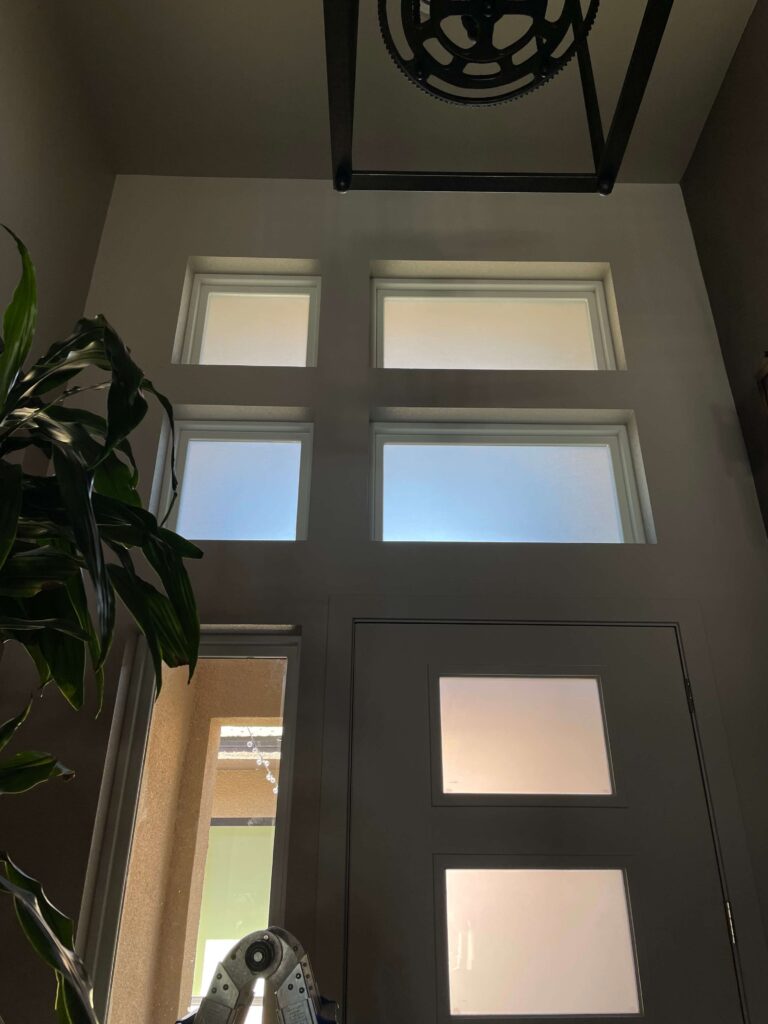
Traditional privacy window film, often called frosted, obscure or decorative film, has a fixed look. Once it’s installed, it stays the same. It can cover a full pane, form a band at eye level, or carry a pattern or logo. (For a closer look at the styles, see our October blog on frosted, patterned and gradient film.)
It doesn’t need power or controls, and there’s nothing to switch. The trade-off is that you can’t make the glass fully clear again when you want an open view.
How much a static film hides depends on the product, the frost level, the lighting and the viewing direction. At night, with lights on inside, what shows through can change. That’s why it helps to see samples on your own glass.
Smart Film vs. Privacy Film: Side by Side
| Smart film (switchable) | Traditional privacy film (static) | |
|---|---|---|
| Appearance | Changes between frosted and clear | Fixed frosted, patterned or decorative look |
| Power | Needs a power supply and control | None |
| Control | Switch, remote or similar control | No control needed |
| Planning | Power access and wiring path need to be planned | Mainly glass type, size and design choice |
| Best fit | Glass that needs privacy only some of the time | Glass that needs the same level of privacy all the time |
| Main purpose | Privacy on demand | Privacy, design and visual separation |
Neither option is a heat-control product by default. If solar heat or glare is the main concern, solar window film is a separate conversation.
Where Smart Film Makes Sense
Smart film tends to fit spaces where the need for privacy changes during the day:
- Conference rooms and glass offices: open and bright between meetings, private during them.
- Medical and wellness spaces: exam or consultation rooms where privacy matters at certain times.
- Glass partitions: interior walls that separate a space without closing it off.
- Select residential spaces: for example, a home office or bathroom glass where homeowners want to switch between open and private.
Where privacy is needed all the time, such as a bathroom window facing a neighbor or a street-facing office pane, traditional privacy film is often the simpler fit.

What to Plan for Before Choosing Smart Film
A few questions help decide whether smart film is the right choice:
- When do you need privacy? All day, some of the day, or only during meetings or appointments?
- Which way should it fail? If power is off, should the glass be private or clear?
- Where is power available? Smart film needs a power source near the glass and a path for wiring.
- What glass is it going on? The type and condition of the existing glass affect how the finished installation looks.
- How will you control it? A wall switch, a remote, or something else.
In many projects, coordination with an electrician is part of the plan. Working that out early makes the installation smoother.
How Window Tint Films LV Can Help
Window Tint Films LV installs smart film as well as frosted and decorative privacy films for homes and businesses across the Las Vegas area. We start by asking what’s happening in the space, when privacy matters, and what you want to keep, such as natural light or an open feel. Then we talk through which option fits, including what each one can’t do. You can also see our recent work.

Planning a conference room, office or other space where privacy needs to change? Call 702-483-4394 or contact us to set up a complimentary on-site consultation.
Smart Film FAQs
Does smart film work on existing windows?
Yes. Retrofit smart film is applied to existing glass, so the glass doesn’t have to be replaced. The type and condition of the glass affect how the finished installation looks, so it’s checked first.
Is smart film frosted or clear when the power is off?
It depends on the product. The most common type is frosted when off and clear when on. Some versions work the opposite way. Choose based on whether the space should default to private or open.
Does smart film need an electrician?
Smart film needs a power supply and a control near the glass. Depending on the setup, an electrician may be needed to provide power. That’s worked out during planning.
Does smart film block heat?
Smart film is mainly a privacy product. If heat or glare is the main concern, ask about solar window film instead.
Is traditional privacy film still a good option?
Yes. When glass needs the same level of privacy all the time, frosted or decorative film is often simpler and doesn’t need power or controls.
Call: (702) 483-4394